
The true cost of property finance is not always shown in the rate
Richard Stettner

Published:
Bridging Finance
Property Investment
The interest rate is understandably one of the first things a property investor asks about when considering bridging finance.
It matters. Bridging is short-term borrowing, and even a relatively small difference in the monthly rate can affect the total cost.
But the lowest rate does not necessarily identify the facility that will work best for the transaction.
Two bridging facilities can provide different net advances, require different levels of borrower capital and treat interest in different ways. They may also vary in term, repayment conditions, security requirements and the amount due at redemption.
The more useful question is therefore not simply:
Which lender is offering the lowest rate?
It is:
What will each facility cost, provide and require over the likely life of the transaction?
This article focuses on unregulated bridging finance used for property investment and business purposes. It does not cover conventional buy-to-let mortgages or regulated residential borrowing.

Look beyond the headline rate
The interest rate is only one part of the facility
The quoted rate shows the charge for borrowing, but it does not reveal the complete commercial effect of the facility.
It may not tell the investor:
How much money will actually be released at completion
How much cash they must contribute
Whether interest must be paid monthly
Which fees will be deducted from the advance
Whether minimum interest applies
Whether the facility can be repaid early without additional cost
What security or guarantees are required
What happens if the exit is delayed
This is why bridging facilities should be compared as complete structures rather than as rates in isolation.
Start with the net amount available
A lender may refer to a gross facility, a maximum loan-to-value or an indicative loan amount. Those figures do not necessarily represent the cash the borrower will receive on completion.
The amount available may be reduced by:
Arrangement fees
Retained interest
Valuation costs
Legal costs
Administration charges
Adviser fees, where applicable
The figure that matters at completion is the net advance: the amount actually available to fund the transaction.
An investor should therefore ask:
After all deductions, how much money will reach my solicitor?
A facility with a lower rate may provide a smaller net advance. If so, the borrower will need to contribute more of their own capital.
That may be entirely acceptable, but it must be understood before the facility is selected.
How will the interest be treated?
Unlike a conventional buy-to-let mortgage, bridging finance may allow interest to be structured in different ways.
Serviced interest
The borrower pays the interest during the loan term, usually each month.
This may reduce the amount due at redemption, but it creates an ongoing cash-flow commitment.
Retained or rolled-up interest
Interest is allocated within the facility or added to the balance instead of being paid monthly.
This can reduce monthly cash-flow pressure, but it may also reduce the net advance or increase the amount due when the bridge is repaid.
Part-and-part interest
Some interest is serviced monthly and the remainder is retained or rolled up.
No one approach is automatically better. The appropriate structure depends on the borrower’s available capital, cash flow, intended term and exit.
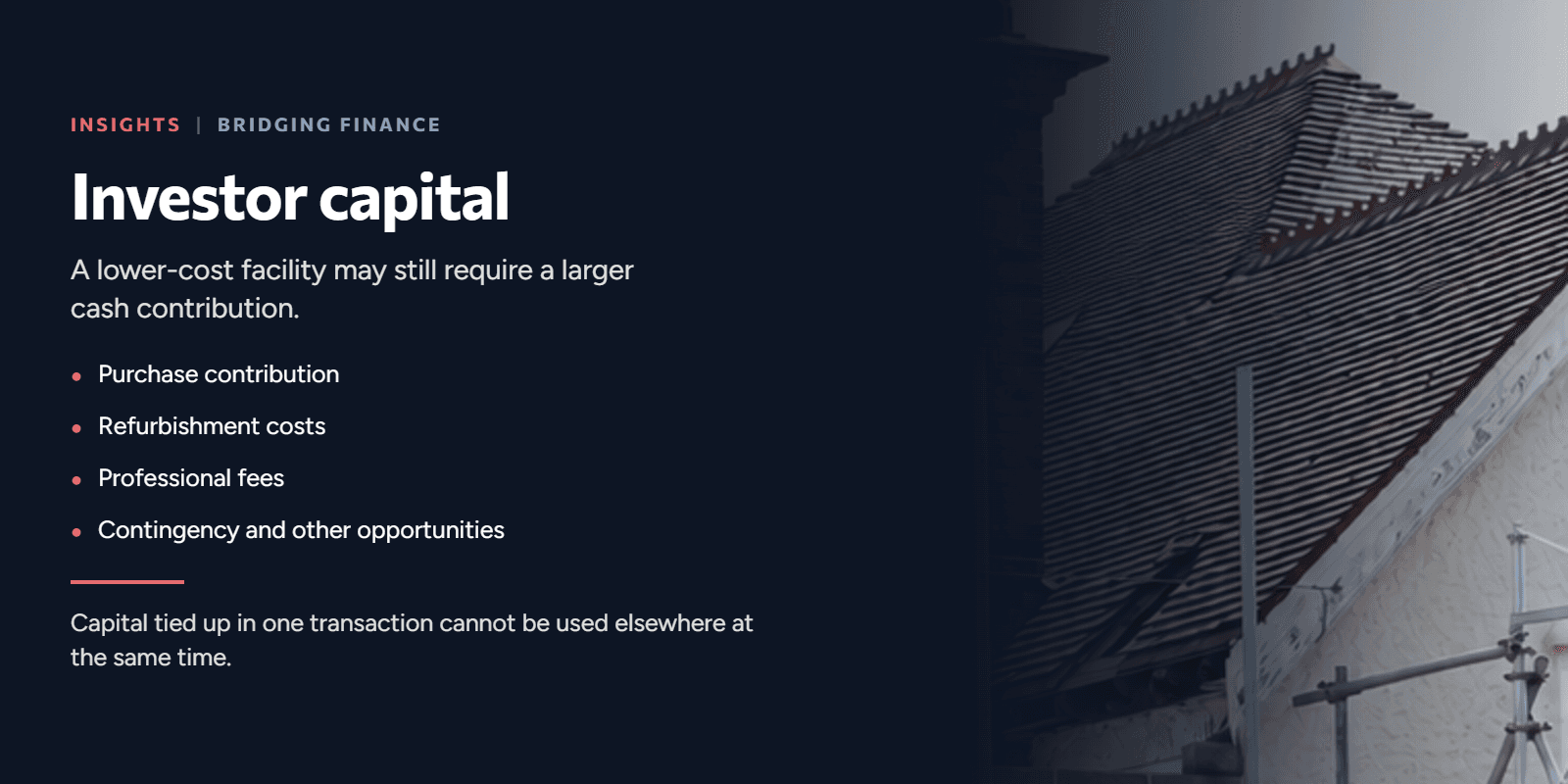
How much investor capital will be tied up?
The borrower’s contribution should not be assessed only as a percentage of the purchase price.
The investor may also need capital for:
Stamp duty land tax
Refurbishment
Professional fees
Insurance
Holding costs
Contingency
Another acquisition
Capital committed to one transaction cannot be used elsewhere at the same time.
That does not mean investors should always maximise leverage. Greater borrowing may increase both cost and risk.
It means the investor should understand the trade-off between lower finance costs and preserving working capital.

Compare the complete commercial outcome
A simplified comparison
Consider an investor purchasing a property for £500,000.
The property requires improvement before it can be refinanced onto longer-term investment finance. The investor expects to repay the bridge after nine months.
For simplicity, the example excludes legal costs, valuation charges, tax and refurbishment expenditure.
Facility A: lower rate with serviced interest
Net loan before the arrangement fee: £325,000
Monthly interest rate: 0.70%
Arrangement fee: 2%
Interest paid monthly
Net funds after the arrangement fee: £318,500
The investor would need to contribute approximately £181,500 towards the purchase price.
Monthly interest would be:
£325,000 × 0.70% = £2,275
Over nine months, the interest would be:
£20,475
Including the arrangement fee of £6,500, the simplified finance cost would be:
£26,975
Facility B: higher rate with more net funds and no monthly payment
Net funds available at completion: £350,000
Monthly interest rate: 0.88%
Arrangement fee: 2%
Interest retained or added to the repayment balance
No monthly interest payment assumed
The investor would need to contribute approximately £150,000 towards the purchase price.
Over nine months, the simplified interest cost would be:
£27,720
Including the arrangement fee of £7,000, the simplified finance cost would be:
£34,720
What does the comparison show?
Facility A is cheaper by approximately £7,745 over the assumed nine-month term.
Facility B, however, leaves the investor with approximately £31,500 more cash at completion and removes the assumed monthly interest payment of £2,275.
That does not make Facility B the better facility.
It creates a commercial question:
Is preserving £31,500 of capital worth an additional expected finance cost of £7,745 in this transaction?
For an investor with ample liquidity, the answer may be no.
For an investor who needs the capital to complete the refurbishment, maintain a contingency or avoid raising funds elsewhere, the answer may be different.
The point is not that a higher rate is preferable. It is that the rate cannot answer the question on its own.

Model repayment, timing and the exit
Compare the cost at the expected repayment date
A bridging facility should be modelled against the borrower’s realistic exit date.
If repayment is expected after nine months, the comparison should show the likely cost at nine months. It should also show what happens if the exit occurs earlier or later.
Relevant questions include:
Is there a minimum interest period?
Is interest calculated daily?
Is there an early repayment charge?
Is there an exit fee?
Is unused retained interest credited back?
What happens if the facility runs beyond its original term?
Each facility must be assessed using its own terms.
A low monthly rate may be less attractive if minimum interest or repayment charges increase the cost at the anticipated exit date.
Allow enough time for the exit
Investors naturally want to keep the bridge term as short as possible.
However, a facility structured around the most optimistic exit date may leave too little room for delay.
Possible causes include:
Refurbishment taking longer than expected
Unexpected defects
Legal or title issues
Valuation delays
A slower sale
Letting delays
Changes in longer-term lender criteria
A refinance taking longer than anticipated
The shortest term is not necessarily the most suitable term.
The facility should allow enough time to complete the business plan and repay the loan, with a reasonable margin for delay.
Completion speed should be assessed realistically
Bridging finance is often used because timing matters.
This may include:
Auction purchases
Contractual completion deadlines
Expiring facilities
Time-sensitive acquisitions
Properties that cannot yet support long-term finance
Before relying on a proposed timescale, the investor should establish:
Whether the lender has reviewed the actual transaction
Whether the property is acceptable
What valuation is required
Whether solicitors have been instructed
Which documents remain outstanding
Whether the intended exit has been considered
Whether there are unusual legal, title or planning issues
A low-priced facility has limited value if it cannot complete within the required timetable.
But neither should the investor assume that a more expensive facility will automatically complete faster.
The exit should shape the facility
Bridging finance is short-term funding, so the borrower needs a credible method of repaying it.
Common exits include:
Sale of the property
Refinance onto buy-to-let finance
Refinance onto commercial property finance
Refinance after refurbishment
Repayment following the sale of another asset
An investor planning to refinance after refurbishment should consider:
Whether the completed property will meet the intended lender’s criteria
Whether the anticipated valuation is realistic
Whether the expected rent will support the refinance
Whether sufficient time is available
What alternative exit is available if the original plan is delayed
The facility should not merely enable the purchase. It should also support a realistic route out.

Assess security, risk and the decision
Security and guarantees form part of the comparison
The cost of bridging finance is not limited to interest and fees.
Borrowers should also understand what the lender requires as security.
This may include:
A first or second legal charge
Additional property security
A personal guarantee
A company debenture
Cross-collateralisation
Conditions governing the release of security
The borrower should consider not only what the facility costs, but also what risk and control they are giving the lender.
Appropriate legal advice should be obtained before accepting security documents or guarantees.
Questions to ask before choosing a bridge
Before selecting a facility, an investor should establish:
How much will actually be released at completion?
Which fees and interest will be deducted?
Will interest be serviced, retained or partly serviced?
What will the facility cost at the expected repayment date?
Are there minimum interest, early repayment or exit charges?
What happens if the exit is delayed?
Is the proposed term realistic?
What security and guarantees are required?
Does the intended exit meet the lender’s requirements?
How much investor capital will remain after completion?
Choose the facility that fits the transaction
The Kinetic Money perspective
Rate is important, but it should be assessed within the complete structure of the transaction.
A cheaper bridge may be the right choice where the investor has sufficient capital, can comfortably service the interest and has a strong exit.
Another investor may reasonably accept a higher expected cost to preserve working capital, avoid monthly payments or meet a critical completion date.
The purpose of structuring is not to justify expensive borrowing.
It is to understand the cost, capital requirement, risks and trade-offs before committing to a facility.
Assess the whole facility
The lowest bridging rate may produce the lowest finance cost.
But that conclusion can only be reached after confirming the net advance, fees, interest treatment, repayment provisions, security, term and intended exit.
The most appropriate bridging facility is the one that supports the transaction while keeping cost and risk proportionate.
If you are considering a property acquisition or short-term refinance, Kinetic Money can help you assess the available bridging structures and their likely commercial effect.
The worked example is simplified and illustrative. It is not a quotation or recommendation and does not represent a particular lender’s terms. Actual rates, fees, net advances, interest calculations, security requirements and repayment amounts depend on the borrower, property, transaction, term and lender criteria. Legal, valuation, tax and other costs have not been included.